
Net per car and driver
With Uber Fleet and Bolt Fleet connected, revenue after platform commission appears per car and per driver – no more copying from two portals.
A Mietwagen (a licensed private-hire car with driver) on Uber or Bolt only pays off if each car still has money left every month after platform commission, fuel, leasing, insurance, workshop and driver wages. In our fictional example, three cars with the same wage range from +$732 to −$403 a month. What matters is the result per car, not the fleet total.
Get a free assessment for your fleet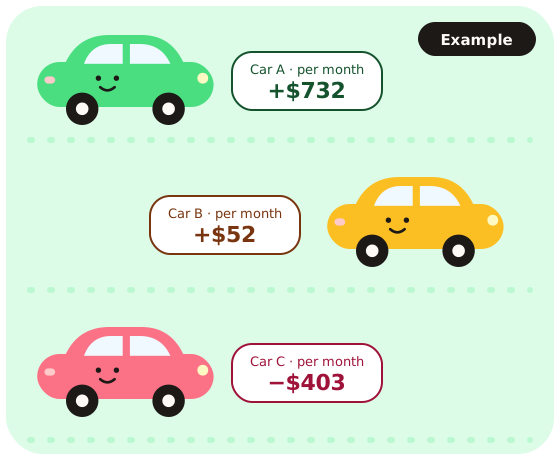
Each month a Mietwagen costs its operator commission, fuel or charging, leasing, insurance, workshop bills and the driver's wage. The table shows three fictional cars in a small fleet with identical wages. The fleet total is +$381, yet car C eats more than half of what car A earns.
| Item | Car A hybrid saloon | Car B estate | Car C van |
|---|---|---|---|
| Fares (Uber + Bolt) | $6,400 | $5,600 | $5,500 |
| Platform commission (example 25%) | −$1,600 | −$1,400 | −$1,375 |
| Revenue after commission | $4,800 | $4,200 | $4,125 |
| Fuel / charging | −$520 | −$640 | −$720 |
| Leasing / financing | −$480 | −$420 | −$590 |
| Insurance | −$260 | −$240 | −$290 |
| Workshop / tyres | −$120 | −$160 | −$240 |
| Driver wage incl. employer share | −$2,688 | −$2,688 | −$2,688 |
| Kilometres driven | 5,200 km | 5,000 km | 4,800 km |
| Cost per km (excl. commission) | $0.78 | $0.83 | $0.94 |
| Revenue per km after commission | $0.92 | $0.84 | $0.86 |
| Result per month | +$732 | +$52 | −$403 |
Not included: office, tax adviser, licence fees and your own working time. Spread these across all cars on top.
Because the second car needs an employed driver. As long as you drive your first car yourself, your own wage stays invisible: whatever is left is your income. From the second car on, the wage is a fixed line in the calculation, however good the shift was.
The German statutory minimum wage (Mindestlohn) is EUR 13.90 gross per hour since 1 January 2026 and rises to EUR 14.60 on 1 January 2027 – in 66 days. Source: § 1 MiLoV5
The example driver earns $14.00 per hour. If the wage has to rise by 60 cents an hour to reach the new minimum, that is 160 h × $0.60 = $96 more gross, or $115.20 more per car and month with the 20% employer share. Car B drops from +$52 to −$63.20, car C to −$518.20.
Five levers drive the result of a Mietwagen. Most of them only become visible once revenue and costs are booked to the same plate.
Wages run by the hour, whether the car is busy or not. A car with lots of idle time can't carry its driver. Moving shifts into busy hours often does more than any cost cut.
German law requires a Mietwagen to return to its base right after each job unless it received a new order before or during the trip (the "return-to-base rule"). These return trips burn fuel but earn nothing. § 49(4) PBefG
In the example, the van is the most expensive on leasing, fuel and workshop, but doesn't earn it back in fares. Check whether a bigger car really brings more trips.
Insurance, leasing and workshop rates are often agreed car by car. Seeing them per plate shows the outliers and tells you where to compare offers.
Commission is charged on every platform fare. Trips from your own direct customers, booked without a platform, lift the result of every car, even if there are only a few at first.
Each extra car needs an entry in your licence, drivers with a P-Schein and a yearly roadworthiness test. The checklist with the legal basis:
Kleinflotte books revenue and costs to each registration plate automatically. Instead of a spreadsheet at the end of the month, you see at any time which car pays its way and which doesn't.
With Uber Fleet and Bolt Fleet connected, revenue after platform commission appears per car and per driver – no more copying from two portals.
Leasing, insurance, fuel and workshop bills land on the right car, so outliers show up before they add up over months.
The dashboard puts cost per kilometre and profit per vehicle side by side – the same figures as the worked example, with your real numbers.
HU, insurance and Konzession: you get a warning before they expire instead of having to take a car off the road overnight.
700+
operators already run drivers, vehicles and platform data with this software – instead of spreadsheets and WhatsApp groups.
When one operator compared costs per vehicle, it turned out that one of their vans was losing a few hundred a month – a car like car C in the example, which never stood out in the fleet total.
Add plates, leasing rates, insurance, deadlines and drivers once. With two to five cars, that's done quickly.
Link your platform accounts. From then on, trips and revenue arrive automatically per car and per driver.
Revenue per driver and car, cost per kilometre, net result after commission and upcoming deadlines at a glance.
You pay per driver, not a flat fee. With three drivers that's from $17.97 a month – less than one example car hands over in commission in a single day.
from $5.99 per driver/month
It depends on each car. A Mietwagen pays off when something is left every month after platform commission, fuel, leasing, insurance, workshop and driver wages. In our fictional example, three cars with the same driver wage range from +$732 to −$403 a month. So work out each car on its own.
There is no fixed figure, but there are fixed cost blocks: platform commission, fuel or charging, leasing or financing, insurance, workshop and tyres, and the driver's wage. In our example, one car costs between $4,068 and $4,528 a month before commission, of which $2,688 is the driver's wage. Your own figures may differ a lot.
The new car has to be added to your licence. The licence certificate lists the registration plates of the vehicles used, and when you swap a vehicle you submit it to the licensing authority to be updated (§ 17 PBefG). Every driver needs the passenger transport driving permit, the P-Schein (§ 48 FeV), and the car needs a roadworthiness test (HU) every 12 months (StVZO Annex VIII).
The German statutory minimum wage (Mindestlohn) is EUR 13.90 gross per hour since 1 January 2026 and EUR 14.60 from 1 January 2027 (§ 1 MiLoV5). At 160 hours a month, gross pay rises by at least EUR 112 compared with EUR 13.90, plus employer contributions.
Five years at most. Under § 16(4) PBefG, licences for other occasional transport by motor vehicle, which includes Mietwagen services, are valid for at most five years. Your licence certificate shows the exact expiry date.
By assigning revenue after commission and every cost to the same registration plate. The software connects Uber Fleet and Bolt Fleet, assigns trips and costs to each car and shows the net result and cost per kilometre. One operator found a van this way that was losing a few hundred a month.
From $5.99 per driver per month, so from $17.97 a month with three drivers. Setup takes about 48 hours, and you can try it free for two days, no credit card required.
We'll show you what result and cost per car look like for your own fleet.
Leave your details — we'll be in touch this week.